

On June 16, 2026, ATAD Steel Structure Corporation officially published its Environmental Product Declaration (EPD) on The International EPD® System, marking an important step in its journey to enhance environmental data transparency, meet the increasingly stringent requirements of international markets, and strengthen its competitiveness in the global supply chain.
EPD – An International Standard for Environmental Data Transparency
On June 16, 2026, ATAD Steel Structure Corporation officially published its Environmental Product Declaration (EPD) on The International EPD® System, following a rigorous process of independent verification and international technical review with the participation of Bureau Veritas Certification (BVC), under the supervision framework of the accreditation system of SWEDAC – the Swedish Board for Accreditation and Conformity Assessment.
The assessment results provided independent assurance of the accuracy, transparency, and reliability of the data, forming the basis for the approval and official publication of ATAD’s EPD on The International EPD® System, with support from EPD Southeast Asia.
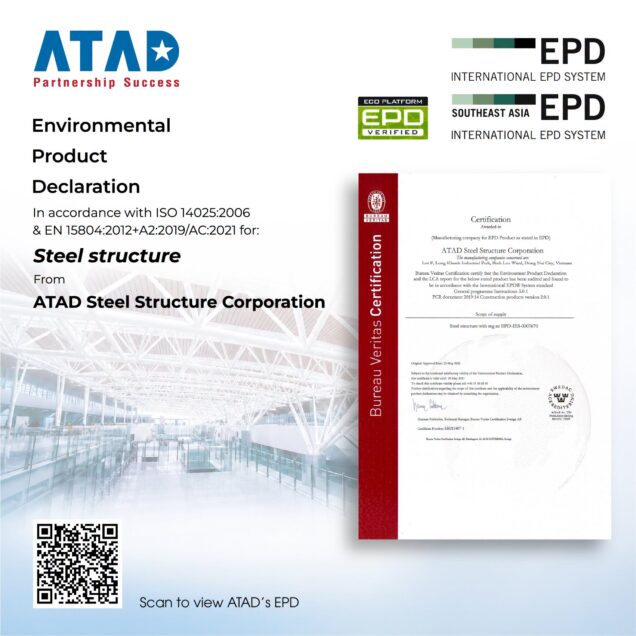
Read more about ATAD Steel Structure Corporation’s EPD on The International EPD® System.
Unlike qualitative environmental claims, an EPD is developed based on the Life Cycle Assessment (LCA) methodology, enabling the environmental impacts of a product to be quantified according to internationally recognized standards and methods.
To meet the stringent requirements of EPD development, ATAD prepared its data in accordance with ISO 14025 for Type III environmental labels and declarations; EN 15804 for the sustainability assessment of construction products; ISO 14040 and ISO 14044 for Life Cycle Assessment; and the applicable Product Category Rules (PCR) for construction products.
The process involved collecting, validating, and evaluating a large volume of data related to raw materials, transportation, production activities, energy consumption, and other environmental information within the declared system boundary.
A Comprehensive Foundation of Management Systems and Data Governance
At ATAD, the publication of the EPD is the result of long-term investment in management systems, operational capabilities, and environmental data governance.
Commenting on this milestone, Mr. Nguyen Thanh Tam, Deputy General Director of ATAD, shared: “The publication of the EPD is not the outcome of a single project. It is the result of years of investment in management systems, data governance capabilities, and environmental information transparency to meet the increasingly demanding requirements of international markets”.
As a company that has delivered more than 4,000 projects in over 60 countries worldwide, ATAD recognizes that providing reliable environmental data will soon become an essential component of competitiveness, alongside quality, safety, and schedule performance – the core values the company has built over more than two decades.
From the early stages of its development, ATAD has built its manufacturing operations on internationally recognized management systems and certifications, including ISO 9001, ISO 14001, ISO 45001, AISC, CWB, CE Marking, IAS AC472, AS/NZS 5131, and H-Grade. These foundations not only help ATAD maintain quality and execute steel structure projects in accordance with international standards, but also establish robust process control, traceability, and data governance across its entire production and business operations.
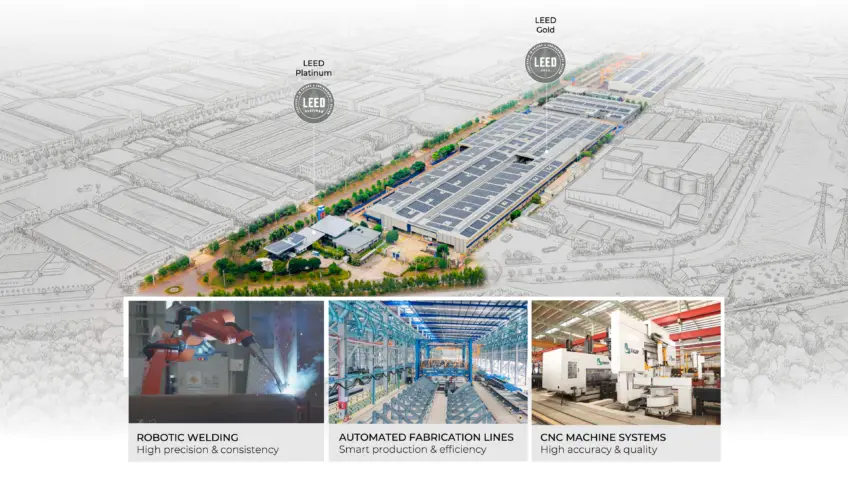
ATAD’s commitment to sustainable development is further reflected in the LEED Gold and LEED Platinum certifications achieved across its facilities, representing international recognition of resource efficiency, environmental performance, and the sustainable manufacturing direction that ATAD has consistently pursued over the years.
Amid growing requirements for carbon emissions management and environmental transparency, ATAD continues to expand its governance capabilities through the implementation and verification of its Greenhouse Gas Inventory in accordance with ISO 14064-1, as well as the verification of its Product Carbon Footprint (PCF) under ISO 14067.
These initiatives enable ATAD to conduct a more comprehensive review of emission sources across its manufacturing operations, while building a data foundation that can be measured, traced, and verified using internationally recognized methodologies. This also represents an important step in preparing the company to meet increasingly common requirements related to ESG, environmental disclosure, CBAM, and sustainable procurement programs worldwide.
ATAD’s environmental data governance capabilities have been developed in parallel with the execution of large-scale projects across infrastructure, industrial, and energy sectors, including Long Thanh International Airport, H2 Green Steel in Sweden, MRT-7 in Philippines, and many other projects aligned with sustainable development objectives.
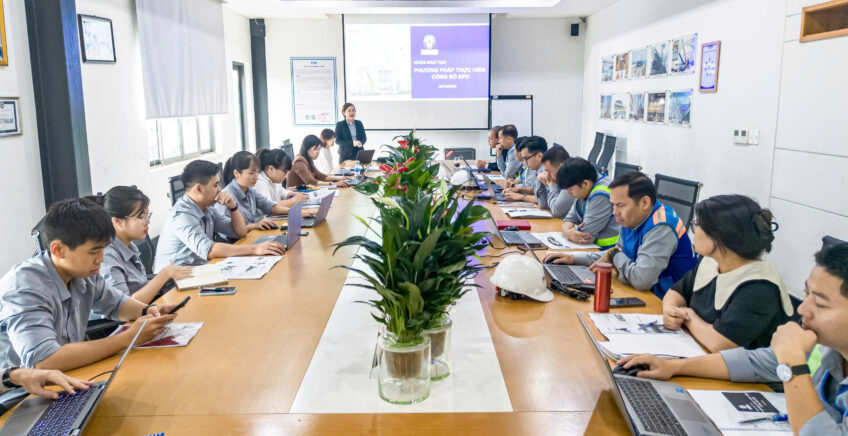
In parallel with the implementation process, ATAD has also focused on strengthening internal capabilities through training programs on ESG, Environmental Product Declaration (EPD), CBAM, greenhouse gas inventory, emission reduction, and Lean manufacturing management. These activities not only enhance employee awareness and technical knowledge, but also help standardize working methods, improve cross-functional collaboration, and foster a data-driven culture that supports sustainability goals across the organization.
In October 2025, ATAD officially launched its EPD development program with the collaboration of multiple functional departments, including Purchasing, Production Planning, Maintenance, Warehouse, Logistics, ESG, HSE, QC, and related operational units. This created a cross-functional effort to build transparent and reliable environmental data.
The implementation process required the collection, review, standardization, and evaluation of data across the entire product life cycle, from input materials, transportation, and production to energy consumption and other related environmental factors.
This is one of the most comprehensive environmental data transparency programs ATAD has ever implemented.
Strengthening Global Competitiveness
For many years, the competitiveness of manufacturing enterprises has often been assessed through product quality, project execution capability, and the ability to meet international technical standards. However, as sustainable development becomes a critical requirement in global markets, factors such as emissions, environmental transparency, and product life cycle data are playing an increasingly important role.
Customers, investors, and international partners are paying greater attention to material origin, carbon emissions, product environmental impacts, and data transparency across the entire supply chain. These requirements are gradually becoming an integral part of global business, from green building programs and ESG strategies of multinational corporations to carbon management mechanisms such as the European Union’s Carbon Border Adjustment Mechanism (CBAM).
EPD is considered a “green passport” that helps products better meet environmental transparency requirements in international markets. The publication of an internationally verified EPD is not only an important milestone in ATAD’s sustainable development strategy, but also a strong affirmation of the company’s capability to meet the increasingly advanced standards of the global market.
This enables ATAD’s customers to access independently verified environmental data, supporting the design process, material selection, and compliance with increasingly common sustainability requirements in international markets.
For ATAD, sustainable development is not a standalone project or a communications-driven initiative. It is a continuous process of improving systems, enhancing operational efficiency, strengthening governance capabilities, and increasing transparency across the entire value chain.
Built on a foundation of transparent data governance, modern manufacturing systems, and a long-term ESG commitment, ATAD continues to strengthen its global competitiveness, accompany customers in green projects, and contribute to elevating the position of Vietnamese enterprises in the global industrial supply chain.