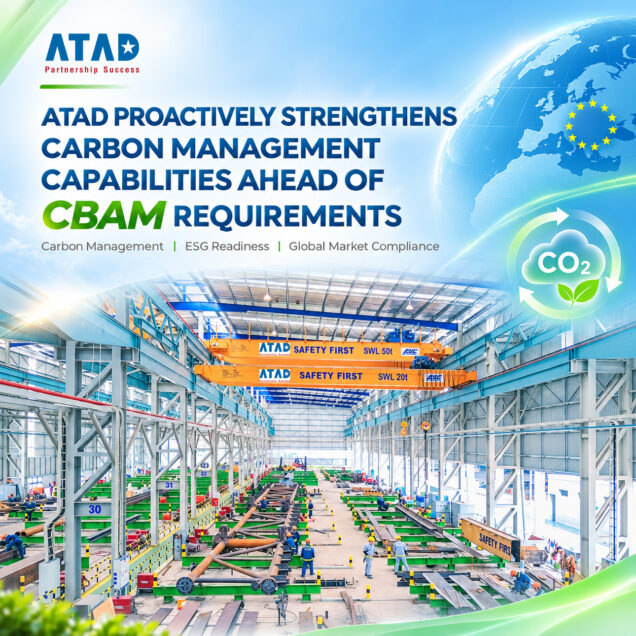
As the European Union’s Carbon Border Adjustment Mechanism (CBAM) enters its definitive phase in 2026, the ability to manage and provide reliable emissions data is becoming increasingly important for businesses operating in international supply chains. Anticipating these evolving requirements, ATAD is proactively strengthening its carbon management capabilities to improve data quality and support customers in meeting applicable CBAM obligations.
What Is CBAM and Why Does It Matter to the Steel Industry?
The Carbon Border Adjustment Mechanism (CBAM) is a European Union regulatory mechanism designed to address the risk of carbon leakage, where production may shift to countries with less stringent climate policies, while promoting fairer competition between products manufactured within the EU and imported goods.
Following its transitional phase from 2023 to 2025, CBAM entered its definitive phase on 1 January 2026.
The mechanism covers selected carbon-intensive product categories, including iron and steel, aluminium, cement, fertilizers, electricity, and hydrogen.
However, not all structural steel products automatically fall within the scope of CBAM. Applicability depends on the relevant Combined Nomenclature (CN) codes, product characteristics, and the EU regulations in force.
For goods covered by the mechanism, embedded emissions information plays an important role in fulfilling the applicable obligations of EU importers.
The Role of Non-EU Manufacturers in Providing Emissions Data
Under CBAM, the legal responsibility for fulfilling the relevant reporting and compliance obligations generally rests with EU importers or the responsible CBAM declarants, as specified by the applicable regulations.
However, meeting these obligations often requires cooperation with manufacturers outside the European Union to obtain information on the embedded emissions associated with imported goods.
This creates an important requirement for manufacturers and suppliers: emissions data must be supported by clear calculation methodologies, traceable information sources, and appropriate evidence that can be substantiated when necessary.
Within the steel supply chain, cooperation among manufacturers, raw material suppliers, and international customers is therefore becoming increasingly important in promoting environmental data transparency.
ATAD Proactively Prepares for Evolving Market Requirements
Recognizing these developments, ATAD has been preparing for CBAM by developing carbon management capabilities from within the organization.
Its efforts focus on strengthening in-house technical expertise, standardizing calculation methodologies, and improving the reliability of emissions data.

Following an intensive CBAM training program in July 2026, ATAD successfully completed the CBAM verification program in August 2026, with the participation of Bureau Veritas Certification (BVC) at both ATAD Long An and ATAD Dong Nai factories.

This milestone represents tangible progress in strengthening ATAD’s emissions data management capabilities, providing a foundation for continuously improving its ability to respond to information requirements from international customers.
For ATAD, proactive CBAM readiness goes beyond monitoring regulatory changes. It means building reliable carbon management capabilities to support customers across global supply chains.
ENGINEERED FOR DELIVERY | BUILT FOR SUSTAINABILITY